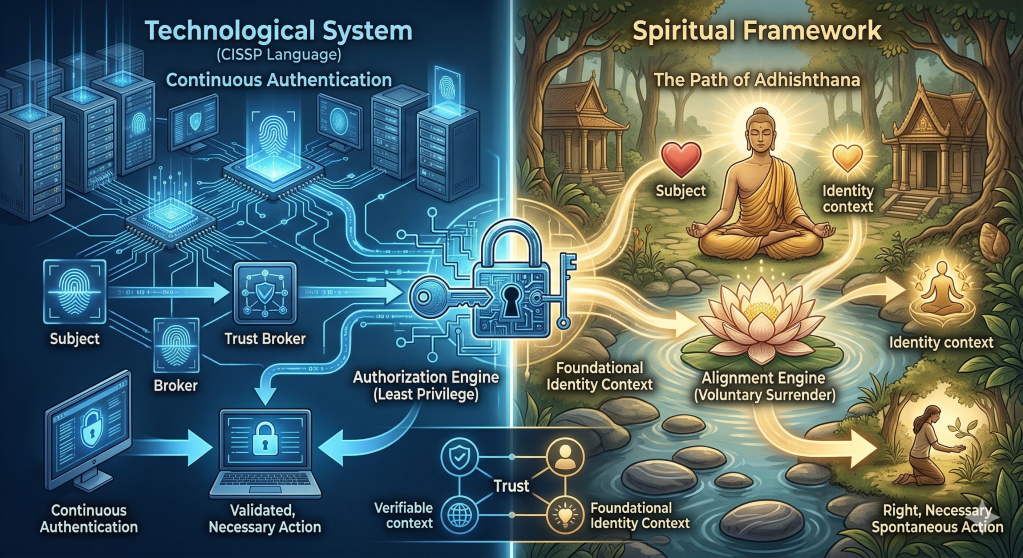
The Continuous Authentication of the Heart
In information security, one of the most important lessons is this: initial trust is never enough.
A user may log in correctly at 9:00 AM. The password may be right. The device may be recognized. Everything may look valid at the start of the session.
But what about ten minutes later? Or an hour later?
What if the user walks away? What if someone else takes over — or the context itself changes? What if the identity that was once verified is no longer the one actually acting?
This is why modern security is steadily moving away from one-time verification and toward something deeper: continuous authentication.
The system no longer asks only, “Who are you?” at the beginning. It no longer asks just once, “Who are you?”
It keeps asking, quietly and intelligently: “Are you still who you claim to be — right now?” It verifies in the background through behavior, rhythm, posture, device context, and patterns of action.
This technical shift, surprisingly, offers a profound way to understand the spiritual life.
Because human beings also make a similar mistake: we think one moment of clarity is enough.
We believe that one prayer, one retreat, one book, one insight, one emotional experience, or one act of devotion is sufficient to permanently align life. But it is not. The problem is not that the moment was false. The problem is that life is continuous. Therefore, truth must also become continuous.
And that is where the ancient practices of Namasmarana and Adhishthana begin to look like the spiritual equivalent of continuous authentication.
The problem with one-time spirituality
Many of us approach inner life the way outdated systems approach identity.
We authenticate once.
We visit a temple and feel peaceful.
We read a sacred text and feel elevated.
We have one moment of surrender and believe something permanent has happened.
We understand a great sentence—Tat Tvam Asi, Aham Brahmasmi, Krishna is the center, All is one—and assume that understanding itself will hold.
But the mind is not a stable machine.
It drifts.
It forgets.
It gets hijacked by fear, pride, distraction, desire, insecurity, comparison, and habit.
So the real question is not whether we have ever known truth. The real question is:
What is running in the background of our consciousness right now?
That is the decisive question.
Because a person may have had a genuine spiritual insight yesterday and still act today from ego, anger, or confusion. In the same way, a system may have performed valid authentication earlier and still be under hostile control now.
The point is subtle but important:
A true beginning is not the same as a continuous state.
Spiritual traditions have always known this. That is why they place so much emphasis not only on revelation, but on remembrance.
Namasmarana as background verification
At first glance, Namasmarana—the repeated remembrance or chanting of the Divine Name—may look like a devotional habit, a ritual repetition, or an emotional comfort.
But perhaps it can also be understood differently.
Perhaps it is a form of continuous background verification.
In cybersecurity, continuous authentication does not interrupt every action with a dramatic pop-up asking the user to prove themselves again and again. It works more subtly. It runs in the background. It watches for alignment. It verifies continuity between identity and behavior. And perhaps, this is not just how systems should work — but how awareness itself operates.
Namasmarana does something similar inwardly.
It keeps the deepest reference point alive.
The name of God—whether one says Krishna, Rama, Shiva, Devi, or simply holds a sacred remembrance—serves as a recurring signal that the mind is not self-sovereign. It reminds us that the ego is not the final authority. It restores orientation.
In that sense, the name is not merely a word. It is a stabilizing context.
Without such context, the mind becomes like an unsecured session: open, active, and easy to hijack.
A person may appear outwardly functional while inwardly operating from compromised identity.
Namasmarana does not instantly solve every problem. But it reduces drift. It keeps reconnecting action to source. It quietly asks:
Are you still acting from truth?
Are you still aligned?
Are you still inwardly authenticated?
Adhishthana: the ground state of being
If Namasmarana is the active remembrance, Adhishthana is the deeper foundation.
Adhishthana may be understood as the underlying ground, the abiding substratum, the stable reality in which all changing experiences arise. In non-dual language, it is the foundational awareness that remains unchanged while thoughts, roles, emotions, and identities come and go.
In technical language, we may say this:
If the ego is the fluctuating user session, Adhishthana is the trusted ground on which all sessions appear.
This is why spiritual maturity is not just about having better thoughts. It is about becoming established in a deeper base layer of awareness.
When a person is not rooted in that ground, they are governed by foreground events. Every passing thought becomes an instruction. Every impulse feels authoritative. Every fear obtains admin rights.
But when one begins to live from Adhishthana, something changes.
The mind still moves.
The world still demands action.
Pain still arises.
Duties remain.
Yet there is a subtler continuity beneath them all—a stable background that does not panic with every fluctuation.
This is where spirituality becomes less theatrical and more architectural.
The question is not: “Did I feel spiritual today?”
The question is: What is my default state when no performance is happening?
That is closer to the truth.
The Principle of Least Privilege and the ego
One of the wisest security principles is the Principle of Least Privilege.
It means a user, process, or application should be given only the minimum permissions necessary to perform its legitimate task—nothing more.
Why? Because excess privilege creates danger.
Too much access leads to abuse, error, damage, and compromise.
Now consider the ego.
The ego wants far more privilege than it needs.
It wants the right to control outcomes.
It wants permanent approval.
It wants the power to rewrite reality according to preference.
It wants unrestricted access to memory, fantasy, identity, status, and fear.
It wants to interfere everywhere.
Most suffering comes not merely from action, but from overprivileged identity.
We do not just do what is needed. We add possession, anxiety, image-management, resistance, and self-importance to it.
A simple duty becomes psychologically inflated because the ego is acting with unnecessary permissions.
But when a person is rooted in remembrance and grounded in Adhishthana, a beautiful simplification occurs: the ego begins to lose excess access.
Action still happens, sometimes very powerfully. But it becomes cleaner.
One says what must be said.
One does what must be done.
One responds to the moment without turning it into a theater of self.
This is not passivity. It is precision.
It is not withdrawal from life. It is better-governed participation in life.
In spiritual language, this may look like surrender.
In security language, it looks like proper authorization.
Why remembrance creates freedom, not restriction
Some people assume that spiritual discipline narrows life. That remembrance, devotion, or surrender must make a person smaller, weaker, or less spontaneous.
But well-designed security does not exist to kill action. It exists to make action trustworthy.
The point of reducing privilege is not paralysis. It is integrity.
A secure system does not stop all processes. It ensures that the right process operates in the right way for the right purpose.
Likewise, genuine spiritual grounding does not make a person lifeless. It removes distortion.
It becomes easier to act without vanity.
To serve without drama.
To decide without fragmentation.
To love without possession.
To endure without collapse.
This is why the deepest traditions do not merely ask us to think about truth from time to time. They ask us to live in remembered relation to it.
Because truth forgotten is not yet transformative.
The heart as a living Zero Trust architecture
Modern security often uses the phrase Zero Trust. It does not mean paranoia. It means that no entity should be trusted merely because it is already inside the system. Every request must be validated in context.
This too has spiritual relevance.
Not every thought deserves trust because it arose within “my mind.”
Not every desire deserves approval because it feels personal.
Not every fear deserves obedience because it sounds urgent.
Inner life also requires discernment.
A thought entering the mind should not automatically receive full access.
It must be examined.
Is it aligned with truth?
Is it born of ego or clarity?
Does it lead to contraction or right action?
Is it authentic, or is it a hijacked signal?
Seen in this light, the spiritual path is not merely moral effort. It is also intelligent governance of consciousness.
The awakened heart is not naïve. It is beautifully verified.
Conclusion: from event to state
Many of us are waiting for a single transforming event.
One perfect insight.
One final revelation.
One unshakable experience.
But perhaps the deeper path is quieter than that.
Perhaps the real movement is from event to state.
From occasional remembrance to continuous remembrance.
From emotional inspiration to stable grounding.
From egoic overreach to least privilege.
From one-time spiritual login to the ongoing authentication of the heart.
That is why Namasmarana matters.
That is why Adhishthana matters.
That is why surrender is not weakness.
A well-governed life is not built on one moment of access. It is built on living continuity with what is most real.
And perhaps that is what spiritual practice has always been:
Not a dramatic declaration of faith,
but a quiet background process of returning,
again and again,
until what is true no longer visits us occasionally,
but begins to live as our default state.
Closing aphorisms
- One moment of insight is like a valid login; it is precious, but not sufficient.
- The mind can be hijacked after revelation just as easily as before it.
- Namasmarana is not repetition alone; it is continuity of orientation.
- Adhishthana is the ground that remains when passing identities fluctuate.
- The ego suffers because it demands excessive privilege.
- Surrender is not loss of agency; it is removal of unnecessary permissions.
- A well-lived spiritual life is a continuously authenticated life.
 Reinvent The Self!
Leave a comment