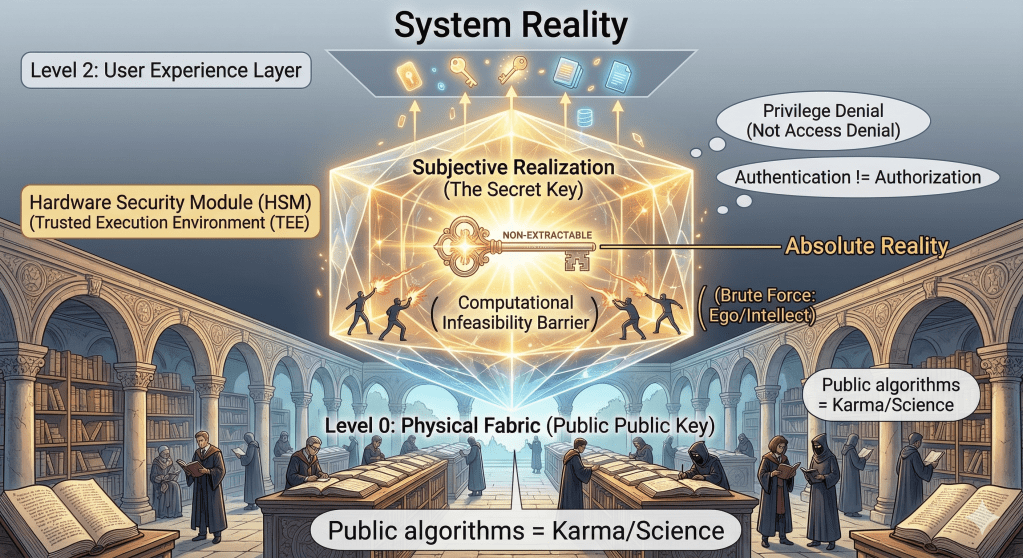
Reality, Secrecy, and the Non-Extractable Key
In security, people often make the same mistake again and again: they think something is secure because it is hidden.
A company hides part of its code.
A developer assumes secrecy itself is protection.
A system is designed in a way that nobody outside the inner circle fully understands.
For a while, this can feel comforting. What is hidden seems safe.
But good security has never fully trusted hiding.
In fact, one of the deepest principles in cryptography says almost the opposite.
A system should remain secure even if its design is publicly known. Its safety should not depend on secrecy of method, but on protection of the key.
This is the spirit of Kerckhoffs’ Principle.
And once you understand it, something remarkable happens: it becomes a powerful way to think not only about cryptography, but also about spiritual life.
Because reality, too, may not be “secret” in the ordinary sense.
Its structure may be visible.
Its laws may be public.
Its pattern may be studied.
And yet, what matters most still cannot simply be extracted.
What Kerckhoffs’ Principle really means
In simple terms, Kerckhoffs’ Principle says this:
A secure system should stay secure even if everything about it is known except the secret key.
This is why modern cryptography does not panic when algorithms become public. People know how AES works. People know how RSA works. People know the logic of digital signatures and key exchange.
The math is not hidden.
And that is not a weakness. It is a sign of confidence.
A mature system does not depend on darkness around the method. It depends on protection of the critical secret.
This is very different from what security professionals call security through obscurity.
Security through obscurity says: “Let us hope nobody discovers how this works.”
That is fragile. Once exposed, the whole system collapses.
Strong security says: “You may know the architecture, the process, the standard, and even the code. But without the key, access is still not yours.”
That is a much deeper model.
Now pause and shift the frame.
What if spiritual life works in a similar way?
Reality may be open, but realization is not public
Human beings often speak as if truth is hidden from us like a locked treasure chest buried somewhere beyond ordinary life.
But perhaps that is not the best way to describe it.
The world is already full of disclosure.
Nature is visible.
Causality is visible.
Patterns are visible.
The rise and fall of desire are visible.
Impermanence is visible.
Suffering is visible.
Interdependence is visible.
Even the highest teachings are often publicly available. Scriptures are printed. Philosophies are taught. Commentaries are archived. Practices are discussed openly.
In that sense, reality is not completely concealed.
The algorithm, so to speak, is not entirely hidden.
What remains unavailable is something else: direct realization.
You can study non-duality without awakening.
You can speak of Krishna without devotion.
You can analyze emptiness without being emptied.
You can explain Brahman without abiding in it.
The structure may be described. The key cannot be borrowed through description alone.
And this is where the analogy becomes powerful.
Spiritual truth may not be withheld as information. It may be protected as realization.
The difference between information and access
One of the most important distinctions in security is this:
Knowing about a system is not the same as having access to what it protects.
A person may understand how a vault works and still be unable to open it.
A developer may know the protocol and still not possess the credentials.
An attacker may know the exact algorithm and still fail because the secret key is beyond reach.
This distinction matters deeply in spiritual life.
Today, information is abundant. A person can spend years reading theology, philosophy, mysticism, psychology, neuroscience, and comparative religion. One can speak fluently about consciousness. One can quote teachings with elegance.
But still something may be missing.
Not because the teaching is false.
Not because the texts are insufficient.
But because information is not realization.
The intellect can describe the path without having walked it to its depth.
This is not a criticism of intellect. The mind is valuable. Study matters. Clarity matters. Language matters.
But there is a threshold beyond which truth is no longer merely understood. It must be lived, suffered, surrendered to, and in some way become one’s very condition.
That threshold cannot be crossed by accumulation alone.
In security terms: the documentation is available, but the key is not downloadable.
The ego wants root access
Why is this so difficult for us to accept?
Because the ego wants more than understanding. It wants possession.
It does not merely want to admire truth. It wants to own it.
It wants certainty as property.
It wants enlightenment as achievement.
It wants realization as an acquisition that strengthens identity.
In other words, the ego wants root access.
It wants full administrative control over the sacred.
But the deeper traditions of the world suggest that this is precisely what is not granted.
The ultimate cannot be dominated by the one who wishes to possess it.
The mind can inquire.
The heart can seek.
The person can prepare, purify, contemplate, and pray.
But the final reality is not handed over as an object in the ego’s inventory.
This is why so many spiritual traditions sound paradoxical at the highest point. They say: lose yourself, surrender, die before you die, empty yourself, let go, become nothing, be still.
To the ego, this sounds like defeat.
But perhaps it is simply the refusal of ultimate reality to grant destructive privilege.
The secure enclave
Modern computing has a useful concept here: the Trusted Execution Environment, or secure enclave.
A secure enclave is an isolated protected environment inside a device. Sensitive operations can happen there. Keys can be stored there. Other parts of the system may request certain operations, but they cannot directly extract the protected secret.
That is the point.
The system can make use of the key without ever exposing it.
This is elegant because it separates function from possession.
Something similar can help us think about the inner life.
There seems to be in human existence a depth that can be approached, participated in, perhaps even lived from — but not mastered by the surface ego.
Call it the Self.
Call it pure awareness.
Call it Atman.
Call it the indwelling divine.
Call it the seat of grace.
The name matters less here than the structure of the insight:
There is a depth within us that cannot be reduced to ordinary mental handling.
The thinking mind can circle it.
Language can gesture toward it.
Practice can purify the approach to it.
But it does not become a possession of the ego.
It remains, in a real sense, non-extractable.
And perhaps that is mercy.
Why the key is protected
At first, this may sound frustrating.
Why should truth not be directly available on demand?
Why should realization not simply be given as clear information?
Why should the deepest thing remain beyond ordinary extraction?
But security gives us one answer.
Some things are protected not because they are cruelly hidden, but because unrestricted access would destroy the integrity of the system.
You do not give every process admin rights.
You do not expose every secret to every layer.
You do not make the master key exportable simply because someone is curious.
Protection is not always exclusion. Sometimes it is the preservation of order.
Likewise, perhaps spiritual realization is not withheld in the way a jealous gatekeeper withholds a secret. Perhaps it remains protected because the egoic mode of consciousness is structurally incapable of holding it correctly.
It would convert truth into status.
It would convert grace into self-image.
It would convert awakening into ownership.
So the problem is not lack of information. The problem is unfitness of the claimant.
This is why the path transforms the seeker before it reveals the center.
Privilege denial, not information denial
This leads to a very important insight.
What if reality is not denying us information?
What if it is denying us privilege?
That is a very different idea.
The laws are visible.
The teachings are visible.
The consequences of action are visible.
The instability of ego is visible.
Even the recurring dissatisfaction of possession is visible.
The world is not silent. It is constantly speaking.
But there is a difference between seeing signs and holding the key.
In that sense, spiritual life is not a puzzle in which God has hidden the clues out of spite. It is more like a secure architecture — where the deepest access cannot be granted to a mode of consciousness built on control, possession, and separateness.
This explains why humility is not just a moral virtue. It is an architectural necessity.
This is why surrender matters.
This is why devotion matters.
And this is where the next layer begins.
Not because these earn truth as a reward, but because they reduce the mismatch between the seeker and what is sought.
Science, philosophy, and the visible architecture of reality
This perspective also helps reconcile technical knowledge and spiritual insight.
Science studies the architecture of the world. It observes patterns, laws, regularities, relationships, structure. Philosophy clarifies concepts. Psychology studies the mind. Ethics studies action. Theology studies meaning and revelation.
These are not enemies of spiritual life.
They are part of the public architecture.
They help us understand the shape of things. They refine our language. They remove confusion. They expose falsehood. They discipline thought.
But even when all of this is done well, a final gap remains between map and realization.
A person may know everything about fire and still not be warmed.
A person may understand devotion and still not love.
A person may define stillness and still never become inwardly still.
The difference is not trivial. It is the whole matter.
And that is why the key remains central.
The soul is not a data extraction problem
Modern people are often tempted to treat inner life as something that can be solved by better analysis alone.
Read enough.
Think enough.
Optimize enough.
Systematize enough.
Decode enough.
Then, perhaps, the final truth will yield.
But the deepest traditions keep returning us to a harder lesson:
The soul is not merely waiting to be decoded. It is waiting to be transformed.
And transformation is not the same as access through force.
You do not break into the sacred.
You are changed in relation to it.
This is why discipline matters.
Why prayer matters.
Why devotion matters.
Why silence matters.
Why ethical life matters.
Not because they are ceremonial extras, but because they prepare the human being to approach what cannot be possessed as an object.
Conclusion: the protected center
A weak system hides its workings and hopes no one notices its flaws.
A strong system can reveal its structure and still remain secure because what matters most is protected at the right depth.
Perhaps the same is true of reality.
Its patterns are not entirely concealed.
Its laws are not entirely hidden.
Its teachings are not entirely absent.
But the innermost key — direct realization — is not a public artifact.
It cannot be stolen by cleverness.
It cannot be exported by ego.
It cannot be reduced to conceptual ownership.
It must be approached differently.
With discipline.
With humility.
With surrender.
With devotion.
With the gradual purification of the one who seeks.
And so the spiritual journey is not merely about finding secret information.
It is about becoming the kind of being to whom the protected center can finally be revealed without distortion.
Perhaps that is why the deepest truths do not arrive as trophies.
They arrive as transformation.
Closing aphorisms
- A weak system hides its method; a strong system protects its key.
- Reality may be visible in structure while remaining inaccessible in essence.
- Information about truth is not the same as realization of truth.
- The ego does not merely want knowledge; it wants possession.
- The deepest center of life is not absent, but non-extractable.
- Spiritual life is not information denial; it is privilege denial.
- The sacred cannot be owned by the self that has not yet surrendered.
 Reinvent The Self!
Leave a comment