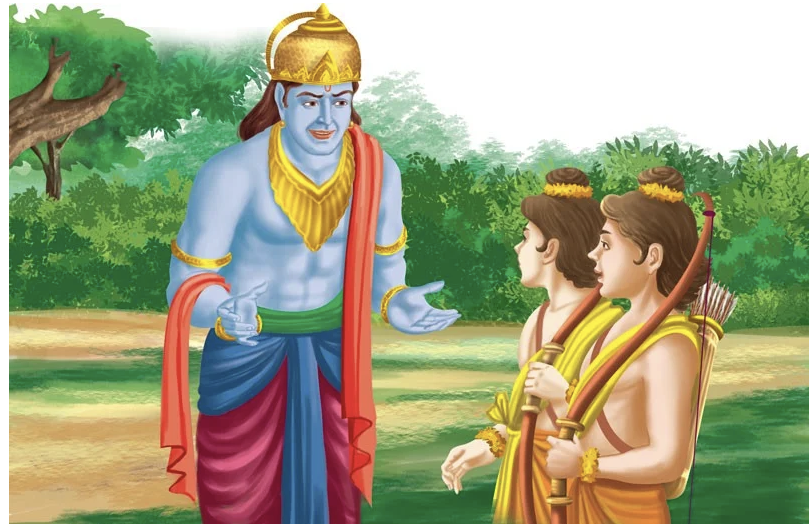
In the great architecture of the Ramayana, Rama stands at the center — the supreme figure, the dharmic axis, the hero around whom the universe of the epic turns. This is as it should be. To diminish Rama is to misread the Ramayana. But to read the Ramayana as if Rama is the only figure worth attending to is to miss something equally important: that every character around him carries their own weight, their own particular virtue, their own irreplaceable contribution to the moral architecture of the story.
I want to dwell on two of these characters — Bharata, and the brothers Luv and Kush. They are usually treated as supporting figures, occasionally even as awkward ones. The tradition tends to celebrate them in ways that almost apologize for what they did. I think this is exactly backwards. What they did was essential — and what they did is also what we systematically refuse to teach our children.
Bharata: When “Mother” Becomes “Enemy”
When Bharata returns to Ayodhya and learns what Kaikeyi has done — that his own mother has engineered Rama’s exile — he does not soften his words. He confronts her directly: “Mata na tu vairini” — you are not my mother, you are my enemy.
This line is uncomfortable. It violates almost every rule we lay down for children about how to address one’s parents. And so the tradition often treats it as a moment of grief rather than a moment of moral clarity, an outburst rather than an act.
But I think it is precisely an act. It is Bharata calling a spade a spade. It is the recognition that the title “mother” cannot be used as armor against accountability. Kaikeyi’s action was wrong, and Bharata’s refusal to dress it up in softer language is what makes him a moral agent and not merely a son.
It is vital to recognize that this moral clarity did not arise from cold, detached calculation. It was fueled by bhakti — an overwhelming, visceral devotion to Rama. Bharata did not merely deduce that Kaikeyi was wrong; his pure love for his brother made her machinations intuitively and immediately repulsive to him. Here, deep devotion does not cloud judgment; rather, it sharpens it, illuminating the demands of dharma when the rules of mere filial piety fall short.
When we teach children “do not talk to elders this way,” we are not wrong to teach respect. We are wrong to teach it as a dictum stripped of context. We teach the rule but not the faculty for evaluating when the rule applies. In information security terms, we teach Mandatory Access Control — the rule applies regardless — when what we should be teaching is Attribute-Based Access Control, where context, attributes, and circumstance determine what the right action is. Bharata’s act is the case study. He did not abandon respect; he saw clearly what the situation actually required, and he spoke to it.
Luv and Kush: The Wisdom of Not Knowing
The case of Luv and Kush is, on the surface, the opposite of Bharata’s — and yet, in spirit, the same.
Rama’s Ashwamedha yajna had set a horse loose, and with it an expansive claim: that sovereignty may extend wherever resistance does not arise. Such claims, even when rooted in sacred duty, require encounter, friction, and examination. Someone had to interrupt this — not from rebellion against Rama, but from the dharmic necessity that even righteous sovereignty must be tested.
To fully grasp the weight of this necessity, we must view the Ashwamedha not merely as an exercise in political assertion or royal expansion, but as what it traditionally was: a king’s sacred duty to establish a unified, peaceful order as a chakravartin. By stepping in front of that horse, Luv and Kush were not merely resisting a king’s claim; they were standing in the path of a massive, competing dharmic institution. Their challenge demonstrates that even the most righteous, institutionally sanctioned movements require the friction of localized dharma to keep them balanced.
Luv and Kush stopped it. Two boys held back an empire. They fought their own father.
But here is the part that fascinates me: they did not know Rama was their father. They could not have known. And had they known, the war could not have happened. They would have folded into the role of obedient sons, the Ashwamedha would have rolled on unchecked, and the world would have been poorer for it.
In Bharata’s case, full knowledge enabled the right action. In Luv and Kush’s case, the absence of knowledge enabled the right action. Same virtue — resistance to a wrong that an elder is committing — opposite epistemic conditions.
This is a lesson we almost never teach. We say: “know everything before you act. Understand the full context.” But sometimes, knowing the full context is precisely what would prevent the necessary act. Sometimes the relationship — this is my father, this is my king, this is my teacher — is exactly the fact that, if held too tightly, makes us complicit in what we should be opposing. Luv and Kush could fight Rama because, for them, Rama was simply a king whose horse had wandered into their forest. The unknowing was the engine.
The Pattern in the Epic
The Ramayana keeps returning to this pattern. Vibhishana abandons his brother Ravana for dharma — choosing the larger moral order over the bond of blood. Kumbhakarna, by contrast, knows Ravana is wrong and says so plainly, yet ultimately fights and dies in loyalty — a counter-foil who shows the terrible cost of letting relationship override viveka. In each case, a sacred bond reaches a threshold past which honoring it would mean dishonoring something larger. The epic seems almost insistent on this point: no relationship, however venerable, is automatic license for compliance.
And yet, in the way these stories are passed down to children, this insistence vanishes. The stories become rules: respect elders, obey parents, do not fight your father. Each rule is true in some narrow sense and catastrophically misleading in another. The point of the stories — the cultivation of viveka, of discrimination, of the faculty by which a person decides what dharma actually requires here, now, with this person, in this circumstance — is exactly what gets stripped away.
Why Rama Still Stands Above All
None of this diminishes Rama. If anything, it requires him. Bharata’s confrontation is legible as virtue because of the dharmic axis Rama provides. Luv and Kush’s challenge carries weight because of who they are challenging. Without Rama at the center, these would be ordinary rebellions. With him, they become something more interesting — dharma testing dharma, and emerging more refined for the test.
Each character in the Ramayana embodies their own swadharma, not a single rule uniformly applied. Rama’s particular dharma, as the eldest son and prince, is to honor his father’s word absolutely. Bharata’s particular dharma, in that same moment, is to confront a parent who has done wrong. Luv and Kush’s particular dharma is to stop an Ashwamedha that nobody else in the world has the standing to stop. None of these contradicts the others. They are different facets of a single, supple, deeply contextual moral order.
What We Should Teach Instead
The problem with our moral education is not that we teach respect for elders. The problem is that we teach dharma as a policy rather than a faculty. We hand children the rule and never train the engine that should be evaluating the rule against the circumstance in front of them. Then we are surprised when they grow up either too rigid to act when action is needed, or too cynical to honor anything when a rule fails them once.
The Ramayana, read whole, is a training manual for that engine. Bharata is part of the curriculum. Luv and Kush are part of the curriculum. They are not deviations from the lesson; they are the lesson.
To teach the Ramayana well is to honor Rama as supreme — and at the same time to let Bharata speak in the voice he actually used, and to let Luv and Kush stand as the brothers who, knowing nothing of who their father was, did exactly what the moment required.
Rama remains above all. But the dharma he embodies is not a ceiling — it is a sun. And around him, in their own complete and irreplaceable way, stand Bharata, Luv, and Kush — quiet teachers of the part of dharma that no rule can ever fully contain. They are
not smaller versions of Rama’s virtue, but entirely different expressions of it.
To teach one without the others is to hand a student the answer key and call it an education.

