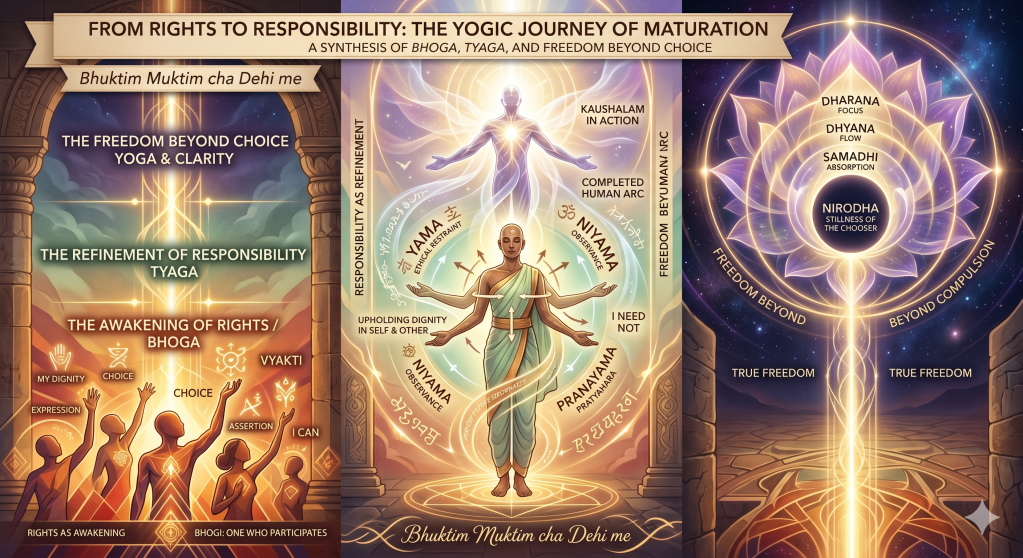
How rights awaken the self, responsibility protects dignity, and yoga reveals action beyond choice
This essay is the first movement in a larger inquiry titled From Rights to Dharma: The Inner and Civilizational Journey of Freedom. It begins not with the state, the law, or institutions, but with the person — the vyakti who first discovers dignity through rights, agency through choice, and expression through participation. Before responsibility can become meaningful, the self must first awaken. A crushed self cannot offer true sacrifice; it can only imitate surrender. So this first essay asks: what happens inside the individual when rights mature into restraint, restraint into responsibility, and responsibility into yoga?
The inquiry will later move outward — from the person to society, from inner discipline to institutional justice, from personal restraint to civilizational kṣamā. But the journey must begin here, because every political philosophy quietly depends on an anthropology. What kind of person is freedom meant to protect? What kind of self is capable of responsibility? And what kind of maturity allows action to arise without the restless compulsion to choose?
There is a strange journey hidden in the ordinary language of rights and responsibility.
We usually speak of rights politically and responsibility morally. Rights belong to constitutions, courts, citizens, and institutions. Responsibility belongs to ethics, family, society, duty, and sacrifice. Because of this, we often treat them as opposites: one protects the individual; the other demands something from the individual.
But I feel there is a deeper movement here.
Rights and responsibility are not merely legal or social categories. They are stages in the maturation of consciousness — and yet, as we will see, even the word “stages” is misleading. They are more like object and stance. The object remains; the stance toward it deepens.
A person first becomes aware of rights because he is a bhogi — one who participates in life, consumes, enjoys, expresses, chooses, asserts, and experiences. But the same person becomes aware of responsibility because he is also a tyagi — one who restrains, offers, sacrifices, disciplines, and eventually becomes free from the compulsion to possess or express everything.
So perhaps the journey of human maturity is not from selfishness to selflessness in a crude sense. It is from unconscious expression to conscious restraint. It is from the utility of choice to the futility of unnecessary choice. It is from rights as awakening to responsibility as refinement — and finally, to that depth in which action no longer feels like choosing at all.
In that sense, when we say:
Bhuktim muktim cha dehi me. Grant me enjoyment and liberation.
We may read it not merely as a request for worldly fulfilment and spiritual liberation, but as a profound map of human development.
Give me bhukti so that I may participate in life. Give me mukti so that I may not be trapped by participation.
Give me rights so that I may awaken as a person. Give me responsibility so that I may not become imprisoned by the very freedom I claim.
And give me, finally, that clarity in which the right action arises by itself — because the chooser has grown quiet.
Rights as the Awakening of the Vyakti
A person is called vyakti.
This word is beautiful because it does not merely mean a biological human being. It points to that which becomes manifest, that which expresses, that which appears distinctly. A vyakti is an expressed being.
Expression is therefore not accidental to personhood. Expression is how personhood becomes visible.
A child first learns to say:
This is mine. I want this. I do not want this. I like this. I dislike this. I can choose. I can say no.
This may look selfish from outside, but it is also the birth of agency. Before a person can serve the world, he must first discover that he exists. Before he can sacrifice meaningfully, he must first possess a self capable of sacrifice.
In Marathi, we say:
आधी स्वार्थ, मग परमार्थ. First self-interest, then higher interest.
But swartha here need not mean crude selfishness. It can mean rightly understood selfhood. It means the minimum dignity of the self. It means the discovery that “I too matter.”
Without this, responsibility becomes dangerous. A person who has never understood his own rights may confuse responsibility with submission. He may call fear duty. He may call obedience sacrifice. He may call collapse humility.
That is not tyaga. That is merely erasure.
True responsibility cannot arise from a crushed self. It arises from a conscious self.
This is why awareness of rights is essential. Rights teach a person the utility of choice. They say:
You may speak. You may move. You may think. You may disagree. You may participate. You may become visible.
Rights are the grammar of expression. They protect the vyakti from being swallowed by family, society, state, tradition, ideology, or power.
But this is only the first maturity.
The Utility of Choice
The first stage of maturity is understanding the utility of choice.
When a person understands choice, he understands rights. He realizes that he is not merely an object in someone else’s world. He is not merely to be instructed, used, classified, or controlled. He has a legitimate claim upon existence.
Choice awakens dignity.
This is why rights matter. A person who has no choice is not yet fully awakened as a moral agent. He may be alive, but his personhood is not yet fully protected. Rights create the space in which the individual can discover himself.
But here lies the danger.
Choice gives the feeling of freedom. It invites us into expression. It tells us: because you can choose, you are free.
And at one level, this is true.
A society without rights is a society of suppressed beings. A person without choice becomes an instrument. Therefore, choice is necessary. Rights are necessary. Expression is necessary.
But choice is not the end of freedom. It is the beginning.
The immature mind says:
I am free because I can choose.
The mature mind begins to see:
I am free because I need not exercise every choice available to me.
This is the second maturity.
Responsibility and the Futility of Exercising Every Choice
A deeper maturity arises when a person understands the futility of exercising choice merely because choice is available.
Just because I can speak does not mean I must speak.
Just because I can consume does not mean I must consume.
Just because I can assert my right does not mean I must weaponize it.
Just because I can win does not mean I must dominate.
Just because I can respond does not mean I must react.
This is where responsibility is born.
Responsibility is not the denial of rights. It is not society telling the individual, “Do not use your rights.” That would be oppression disguised as morality.
Responsibility is the individual discovering from within:
I am not reduced to the exercise of my rights.
This is a subtle but critical distinction.
Rights are necessary so the person can awaken as agent. Responsibility begins when agency becomes refined by wisdom.
So rights are not opposed to responsibility. Rights prepare us for responsibility. By understanding my own dignity, I become capable of respecting the dignity of others. By understanding my own right to expression, I become sensitive to the consequences of my expression. By knowing the value of my freedom, I begin to understand why I must not violate the freedom of another.
Rights awaken the self.
Responsibility disciplines the self.
Rights say: I may choose.
Responsibility says: I need not choose unnecessarily.
Dharma says: choose only when choice serves truth.
Yoga says: rest where even the chooser becomes still.
Bhoga and Tyaga: Expression and Restraint
In this sense, rights belong to bhoga.
Bhoga is not merely indulgence. It is participation. It is the willingness to experience life. It is the outward movement of consciousness into form, relation, taste, touch, action, creation, speech, possession, and identity.
A bhogi says:
I want to experience. I want to express. I want to participate. I want to become visible in the world.
This is not wrong. Without bhoga, life becomes abstract. Without expression, the vyakti never appears.
But bhoga without tyaga becomes greed.
Expression without restraint becomes noise.
Rights without responsibility become entitlement.
Choice without wisdom becomes compulsion.
Therefore tyaga enters.
Tyaga is not hatred of life. It is not rejection of experience. It is not fear of expression. It is the purification of participation.
The tyagi does not necessarily abandon the world. He abandons the compulsion to possess the world. He abandons the need to express every impulse. He abandons the illusion that more choice necessarily means more freedom.
This is the paradox of tena tyaktena bhunjitha — enjoy through renunciation.
Not renunciation as life-denial, but renunciation as purification of enjoyment.
Enjoy, but do not possess.
Express, but do not be possessed by expression.
Choose, but do not be enslaved by choice.
Participate, but do not lose yourself in participation.
Patanjali and the Freedom of Restraint
Patanjali gives one of the most powerful definitions of yoga:
Yogashchittavrittinirodhah. Yoga is the restraint, stilling, or mastery of the fluctuations of the mind.
At first glance, this appears to be against expression.
If vyakti means expression, and yoga means restraint of mental modifications, then is yoga anti-personhood?
I do not think so.
This is where we must distinguish restraint from suppression.
Suppression says:
Do not express because expression is dangerous.
Restraint says:
Do not express prematurely, compulsively, or crudely, so that what finally emerges is true.
Suppression comes from fear. Restraint comes from freedom.
Suppression kills expression. Restraint purifies expression.
Suppression imprisons the vyakti. Restraint perfects the vyakti.
A poet restrains language so that poetry may emerge.
A musician restrains noise so that raga may emerge.
A dancer restrains random movement so that grace may emerge.
A yogi restrains mental fluctuations so that pure consciousness may reveal itself.
So Patanjali is not against expression. Patanjali is against distorted expression.
The purpose of nirodha is not to destroy the mind, but to prevent the mind from compulsively scattering consciousness into restless fragments.
Restraint is not the absence of expression. It is the discipline through which expression becomes truthful.
Expression as the Illusionistic Invitation to Freedom
Expression feels like freedom.
When I speak, I feel free. When I choose, I feel free. When I consume, I feel free. When I assert, I feel free. When I declare my identity, I feel free.
But expression can deceive us.
It can become an illusionistic invitation to freedom.
Why illusionistic? Because the very expression that promises freedom can become bondage.
A person may become enslaved to his opinions. He may become enslaved to his desires. He may become enslaved to his identity. He may become enslaved to his need to be heard. He may become enslaved to the performance of freedom.
The modern world often mistakes expression for liberation. It says: express everything, choose everything, consume everything, display everything, react to everything. But this does not necessarily create freedom. It often creates exhaustion.
The person becomes trapped in endless expression.
He has rights, but no rest. He has options, but no peace. He has visibility, but no depth. He has voice, but no silence. He has choice, but no mastery over the chooser.
This is why restraint is true freedom.
The ordinary person says:
I am free because I can express every impulse.
The mature person says:
I am free because I am not forced to express every impulse.
The yogi says:
I am free because even the impulse arises and dissolves in awareness.
The Difference Between Suppression and Pure Expression
This distinction is essential because many people misunderstand restraint as suppression.
But restraint is not suppression.
Suppression is unconscious restraint imposed by fear, shame, guilt, domination, or social pressure.
Restraint is conscious containment arising from clarity.
Suppression says:
I must not express because I am afraid.
Restraint says:
I will not express yet because the expression is not pure.
Suppression hides the wound. Restraint allows the wound to become wisdom before it speaks.
Suppression creates inner violence. Restraint creates inner alignment.
Suppression is externally imposed. Restraint is inwardly chosen.
This is why restraint enables pure expression.
A thought that immediately becomes speech may be merely reaction. A desire that immediately becomes action may be merely compulsion. An emotion that immediately becomes behavior may be merely wound expressing itself.
But when awareness holds the movement, something changes. The crude impulse is refined. The egoic reaction is filtered. The restless vibration settles. What remains may be truer, cleaner, more compassionate, more necessary.
This is pure expression.
Pure expression is not less expressive. It is more expressive because it carries less distortion. It is not weaker. It is more powerful because it is not leaking energy through compulsion. It is not silent because it has nothing to say. It is silent until speech becomes worthy.
That is restraint.
A Test for Restraint
But how does one tell, from within or from outside, whether what is happening is true restraint or suppression wearing better clothes? The inner test alone is fragile, because the mind is skilled at deceiving itself. Fear can call itself discipline. Avoidance can call itself non-attachment. Collapse can call itself surrender.
A more workable test is this:
Ask whether the restraint protects rights — one’s own and others’ — or whether it violates them.
Restraint that silences one’s own legitimate voice out of fear is suppression of self. Restraint that crushes another’s legitimate expression is suppression of other. Both may wear the costume of tyaga, but neither is tyaga.
Real restraint protects. It holds back the impulse that would have crushed another. It holds back the reaction that would have betrayed oneself. It guards a space — one’s own and another’s — in which truth can emerge.
So the test of restraint is not how quiet one becomes, but whose dignity remains intact when one is quiet.
Rights, Responsibility, and Dharma
Now we can return to rights and responsibility — and define responsibility more precisely.
Rights are the freedom to express.
Responsibility is not merely the freedom to restrain. Responsibility is more active than that.
Responsibility is the upholding of rights — one’s own as well as others’.
This formula has two halves, and both matter.
The “others’” half is well known. We say a responsible person honours the dignity of others, the freedom of others, the space of others. This is true.
But the “one’s own” half is often quietly dropped. And it is precisely where the dropping happens that responsibility decays into self-erasure.
A person who protects only the rights of others, and not his own, is not practicing tyaga. He is practicing self-betrayal. He is teaching the world that his dignity is negotiable, and the world tends to accept the lesson.
True responsibility includes self.
Rights say: I have dignity.
Responsibility says: So does everyone — including me. And I will protect this dignity wherever it is threatened, whether in another or in myself.
This also clears up an old confusion. Rights are not merely a developmental kindergarten that the mature soul outgrows. Rights persist. What matures is the relationship to them. The infant claims rights. The adult protects rights. The wise being becomes the custodian of rights — for self, for other, for those who cannot yet claim them.
Rights and responsibility are therefore not two stages, one replacing the other. They are object and stance. Rights are what is protected. Responsibility is the protecting.
This is also why responsibility without rights is tyranny, and rights without responsibility are immaturity. Dharma is the integration in which the same person is both claimant and custodian — claiming his own dignity, custodian of all dignity.
From “I Can” to “I Need Not”
The deepest movement in this whole inquiry is the movement from:
I can.
To:
I need not.
“I can” is the birth of rights.
“I need not” is the birth of responsibility.
“I choose only what serves dharma” is the birth of wisdom.
“I rest beyond the compulsion to choose” is the birth of yoga.
This does not mean that choice disappears. It means choice becomes transparent. It is no longer an egoic performance. It is no longer an anxious assertion of selfhood. It is no longer a desperate attempt to prove freedom.
Choice becomes an instrument.
And like every instrument, it must be used skillfully.
A sword in the hand of an immature person creates violence. A sword in the hand of a warrior serving dharma becomes protection.
Similarly, rights in the hands of an immature ego become entitlement. Rights in the hands of a mature being become responsibility.
Choice in the hands of desire becomes bondage. Choice in the hands of awareness becomes offering.
The Meditative Axis: When Action Becomes Output
But there is something deeper still than rights and responsibility. And once we see it, we realize it has been beneath the entire arc all along.
Patanjali gave one definition of yoga:
Yogashchittavrittinirodhah. Yoga is the stilling of mental fluctuations.
The Bhagavad Gita gives another:
Yogah karmasu kaushalam. Yoga is skill in action.
These are usually treated as separate definitions — one inward, one outward. But they may be the same definition seen from two sides.
What is skill in action?
The usual reading is: acting without attachment to results. This is true, but it still keeps a chooser in the picture — a chooser who has merely loosened his grip on outcomes.
There is a deeper reading.
Skill in action is the state in which the right action arises as the only one — because the noise that produced the appearance of multiple alternatives has been stilled. The unskilled mind sees options because it is clouded. The skilled mind sees what is to be done because it is clear.
Choice itself, in this sense, is often a symptom of distortion.
Clarity does not choose better. Clarity does not choose.
If this is so, then the meditative axis is not a third dimension running parallel to rights and responsibility. It defines them.
Activity is the output. The actual work happens beneath it — in the clearing or clouding of the ground from which action emerges.
What we call rights are conditions that protect the developmental space in which this clearing can begin at all.
What we call responsibility is the cultivation of the ground itself — restraint, refinement, the protection of dignity in self and other.
What we call yoga is the state in which the ground has become so clear that action arises without deliberation, without ego, without the friction of choosing.
The responsible person does not deliberate better in the moment. The responsible person has already done the work, so that when the moment comes, the right action simply arises.
This is why the deepest dharma cannot be legislated. It cannot be commanded. It cannot even be chosen. It can only be evoked — and the probability of its evocation rises with the depth of preparation.
Rights protect the space. Responsibility prepares the ground. Yoga is the action that arises from the ground when the noise has stilled.
Bhukti, Mukti, and the Completed Human Being
So when we say:
Bhuktim muktim cha dehi me.
Perhaps we are not asking for two separate things.
We are asking for the complete human arc.
Bhukti without mukti binds. Mukti without bhukti can become dry abstraction.
The fullness lies in enjoying without possession, expressing without compulsion, choosing without bondage, restraining without suppression, and serving without self-erasure.
The complete human being is not merely a bhogi. The complete human being is not merely a tyagi.
He is one in whom bhoga has been purified by tyaga, and tyaga has been illumined by clarity.
He participates fully, but is not possessed by participation. He expresses beautifully, but is not enslaved by expression. He knows his rights, but does not weaponize them. He upholds rights — his own and others’ — but does not collapse under the work of upholding. He chooses, but knows the futility of needless choosing. He restrains, but does not suppress. He is a vyakti, but his expression has passed through nirodha. And when action arises through him, it arises as the one thing the moment was asking for.
That is pure expression.
That is mature freedom.
That is kaushalam — skill in action.
Conclusion: The Freedom Beyond Choice
The journey begins with rights because the person must first awaken as a person.
The journey deepens into responsibility because the awakened person must learn to protect what awakened him — for himself and for others.
The journey becomes spiritual when the person realizes that freedom is not merely the ability to choose, but freedom from the compulsion to choose — and that this freedom is not the end of action, but the condition for the only action that is fully real.
Expression invites us into freedom. Restraint reveals the truth of freedom. Clarity makes action transparent.
Rights awaken the vyakti. Responsibility upholds the vyakti — one’s own and others’. Yoga purifies the ground from which the vyakti acts.
Bhoga gives life its colour. Tyaga gives life its clarity. Kaushalam makes life itself an offering.
Suppression kills expression. Restraint enables pure expression. Stillness reveals the only expression that was ever needed.
In the beginning, freedom says:
Let me express.
In maturity, freedom says:
Let me protect what allows expression — in me and in others.
In wisdom, freedom says:
Let only truth express through me, and let me not stand in its way.
And perhaps this is the real meaning of maturity:
First, I discover that I can choose. Then, I discover that I must protect the conditions of choice — for myself and for all. Finally, I discover that the highest action is the one that arises when the chooser has become so quiet that only dharma speaks.
That is why rights are sacred. They protect the space.
That is why responsibility is sacred. It prepares the ground.
And that is why true freedom is not the loud assertion of every possible expression, nor even the careful selection among them, but the quiet readiness through which the one right action becomes the only action — and arises as effortlessly as breath.
This is where the first movement pauses. Rights awaken the vyakti; responsibility refines the vyakti; yoga quiets the chooser so that action may arise as kaushalam — skill in action. But the same question cannot remain only inward. If the individual must learn not to weaponize rights, what must society learn? If the person requires restraint to protect dignity, what does authority require to avoid becoming tyranny? The next essay turns from the inner life of freedom to its civilizational architecture — from personal yoga to political dharma, from the restraint of the self to the forbearance of institutions.
 Reinvent The Self!