
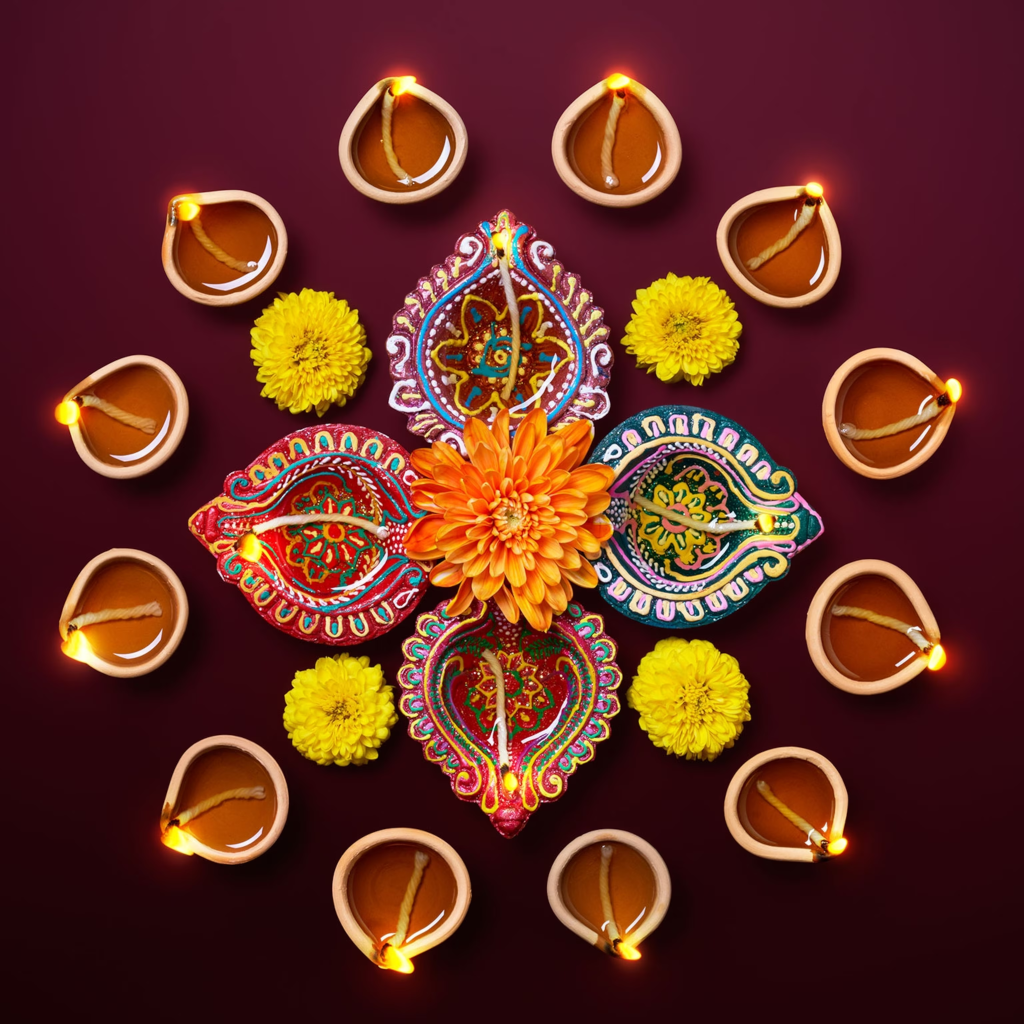
Diwali is India’s grandest festival. Yet beneath the crackle of firecrackers and the glow of earthen lamps lies a precise map of spiritual transformation. Like the allegories encoded in the Ramayana, the birth of Ganesha, or the story of Dhruva, the days of Diwali, taken in order, trace the milestones an aspirant crosses on the path from self-restraint to liberation.
This is what those sacred days signify to me.
Rama Ekadashi: The Foundation of Restraint
Every authentic spiritual journey begins not with expansion but with withdrawal. On Rama Ekadashi the aspirant fasts, a deliberate act of abstinence. True fasting is more than physical hunger. It is continence of attention: reining in the restless senses from their habitual outward drift.
To invoke Rama is to turn toward the one in whom the yogis delight (ramante yogino ‘smin iti ramah). The aspirant turns inward and prepares the quiet ground where sadhana can take root.
Vasu Baras: The Awakening of Prana
Vasu is the life-giving breath. Baras, the twelfth lunar day, hints at the sustained discipline of tapas. On this day we worship the cow and her calf.
Watch a calf in its first moments of life. As air rushes into its lungs and fills its senses, it stumbles, finds its feet, and learns to stand. So it is with the aspirant. Through conscious pranayama and stillness the breath steadies, inner balance is found, and we learn to stand upright on the path, tuned to the primordial vibration of Aum.
Guru Dwadashi: The Grace of Guidance
Sustained practice ripens into readiness. When individual effort (purushartha) reaches its threshold, the Guru appears, just as Rama appears before Hanuman in the forest of Kishkindha. The seeker has done all he can by his own strength; what remains must be given.
The Guru represents the awakening of the Ajna chakra, the eye of intuitive discernment. He dissolves our confusion, points directly toward liberation, and gives the light by which we begin the conscious walk back to the Source.
Dhana Trayodashi: The Vessel of Outer Wealth (Abhyudaya)
Before inner transformation can last, the outer vehicle must be sound. Wealth is of two kinds: the material foundation that supports life, and the hidden treasury of the spirit. Dhana Trayodashi embodies the first.
In invoking Lord Dhanvantari we receive vitality, health, and worldly stability (dhana). Krishna promises in the Bhagavad Gita to secure and preserve what we need (yoga-kshemam vahamy aham). This stage makes us strong and resourceful; in modern terms, antifragile, able to grow under worldly stress rather than break.
Naraka Chaturdashi and Abhyanga Snana: The Purging of Hell and the Dawn of Grace
The number fourteen echoes Rama’s fourteen years in the Dandakaranya forest: a period of unyielding discipline (danda) and penance that rewrites one’s inner character for good.
Our personal hell (naraka) is the accumulated weight of mechanical suffering, rigid conditioning, and the ego’s illusions. On this day Krishna slays Narakasura, and so the divine within slays the demon of our lower nature.
At dawn we take the Abhyanga Snana, the ritual bath in the early twilight. It is not merely cleansing the skin with scented oils; it is bathing in Grace itself. As false beliefs and delusions wash away, the heart overflows with gratitude, and we are immersed in pure bhakti.
Lakshmi Puja: The Dawn of Inner Wealth (Nihshreyasa)
Having steadied material life on Trayodashi and purged our lower nature on Chaturdashi, we arrive on the dark night of Amavasya at the second, higher register of wealth.
This Lakshmi is not gold, coins, or worldly assets; the aspirant has outgrown that realm. She is inner wealth: deep contentment (santosha), undisturbed peace, wisdom, and the company of noble souls (satsanga). As the consort of Vishnu, she dwells wherever total devotion reigns.
Falling on the night of no moon, this day honors the fertile void (shunyata), the infinite potential of the causal body (karana sharira). The mind no longer borrows reflected light from the world, as the moon does. It rests in its own source, unmoved like the pole star Dhruva.
Bali Pratipada: The Total Offering (Atma-balidan)
With the mind purified and rich in spirit, one obstacle remains: the ego itself. As King Bali bowed his head for Vamana’s third step, the aspirant surrenders every sense of individual doership. The “I” dissolves in the final sacrifice (atma-balidan).
Pratipada, the first day of the new lunar cycle, marks the true dawn of a free existence: the state of the jivanmukta, liberated while still living in this body.
Yama Dwitiya: Moving Beyond Death
The journey ends on the second day with Yama and Yami, the twin children of the Sun. Yami is the sacred river Yamuna, the flowing theater of Maya. Yama is the cosmic principle of transition and of law.
How can death frighten one whose false self has already been surrendered? Yama is no longer a specter but an ally who keeps the sacred cycle turning, dissolving what is spent so that creation stays ever fresh. As the Buddha sat unmoved before Mara under the Bodhi tree, the liberated soul meets death without fear.
The circle is complete. As the mystics taught, we remain in this world, yet are no longer of it.
Linguistically, Dwitiya marks the second day of the lunar fortnight. But contemplatively, one can see it as that which comes after Yama. Yama is the boundary of mortality and dissolution. To encounter the ‘second’ after Yama is to ask: what remains when the fear of death has been crossed? It is the life of the liberated—life on the other side of dissolution.
May this festival of lights guide each of us through its inner stages, from the grip of conditioned habit into the unshakeable light of conscious freedom.
Tamaso ma jyotir gamaya.
Happy Diwali!


You must be logged in to post a comment.