
There is a strange pattern that shows up across traditions if you look closely enough.
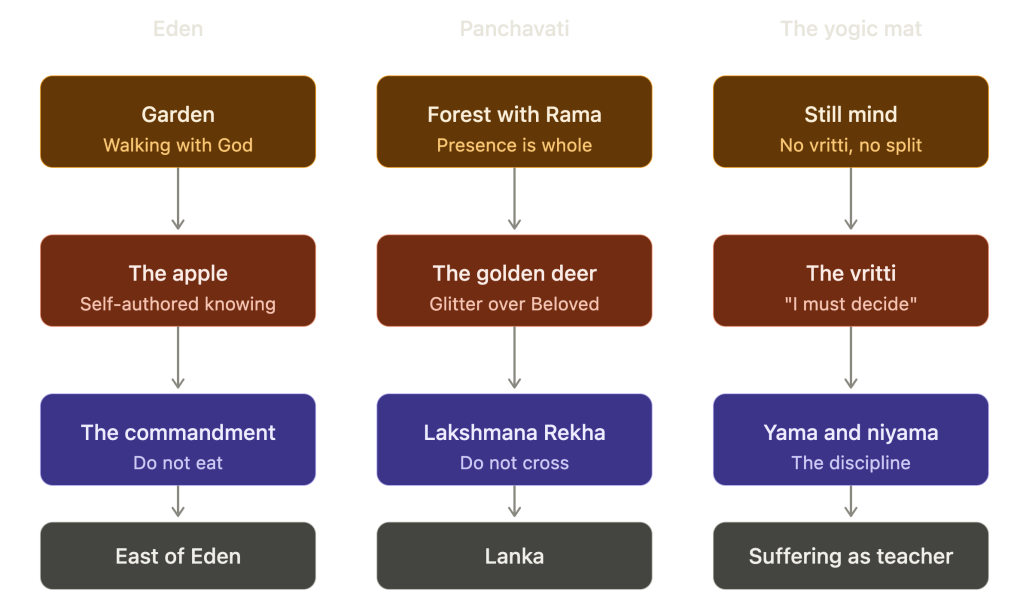
A woman in a garden reaches for a forbidden fruit. A queen in a forest turns toward a golden deer. A seeker on a mat listens to a terse Sanskrit line: Yogah chitta vritti nirodhah — yoga is the stilling of the movements of the mind.
On the surface, these scenes live in different worlds: Biblical myth, Itihasa, and classical yoga philosophy. Underneath, they are circling the same paradox. What we usually call freedom — the ability to choose, to reach, to follow a new possibility — is often the first step away from the only freedom that really matters.
The First Turning
In Eden, the story goes, there is no gap between God and the human pair. Presence is the air they breathe. The prohibition — do not eat from this tree — is not yet felt as a shackle; it is simply part of the given order. There is no inner argument about it, because there is not yet an inner split.
Then the serpent introduces a new possibility: you could step outside this given wholeness. You could know for yourself. You could become like God in your own right. The apple is not just a fruit; it is the first invitation to self-authored knowing.
The real drama happens before the bite. It happens in the turning of attention. The tree, which had always been there, suddenly becomes charged. It is now the symbol of a choice: obey or transgress, stay within given presence or step into self-claiming freedom. The bite only seals what the mind has already done.
In the Aranya Kanda of the Ramayana, something very similar unfolds in a different idiom. Sita is in the forest with Rama and Lakshmana, in the safety of his presence. A deer of impossible gold appears at the edge of the clearing. Rama warns. Lakshmana warns. She insists.
Again, the crucial moment is not the kidnapping; it is the prior turning of gaze. The deer is not evil. The desire is not monstrous. But something subtle has already shifted: the glittering thing outside has become more compelling than the living Beloved within arm’s reach.
In both stories, original sin is not primarily about disobedience as a legal category. It is about the soul’s first experiment with stepping out of seamless presence into the drama of choice.
This is not a feminine failure. It is a human pattern, told in these traditions through feminine figures because they stand close to life, desire, embodiment, and relational presence. Adam falls too. Every seeker falls. The point is not gender but the movement of consciousness.
The Four Layers Revisited
Elsewhere, I described the Ramayana as quietly enacting four layers of refuge — presence, faith, boundary, causality — each catching you when you fall from the previous one.
Presence is direct immersion in the Lord, with no gap, no question of faith because nothing is missing. Faith is the rope you hold in the dark when presence is not felt — trust without seeing. Boundary is the Lakshmana Rekha, the commandment, the shastra — the external rule that protects you when inner clarity has wavered. And causality is the bare floor of reality, where consequences teach you what gentler means could not.
Read this way, Sita’s story is the geometry of a fall: presence falters at the deer, faith fails at the illusory cry, the boundary is crossed at the threshold, and then causality delivers her to what waits outside the line.
The Eden story traces the same arc in a different mythic language. Presence is the garden. The command not to eat is the boundary. Faith — trust in the Giver’s goodness — is what the serpent erodes. When the boundary is crossed, the couple meets the fourth layer: the world east of Eden, where toil, distance, and death enter the picture as teachers rather than arbitrary punishments.
In both cases, the freedom to leave presence has been granted — and reality, patient and severe, rearranges itself into a ladder of instruction.
In information security, this would be called defence in depth. No serious system relies on a single control. If identity fails, policy catches. If policy fails, monitoring catches. If prevention fails, response remains. The Ramayana reveals a divine version of the same principle. Presence is the original secure state. Faith is the first compensating control. Boundary is the external safeguard. Causality is the final audit trail of reality itself.
God loves us so much that even when we try to break free into the illusion we call freedom, He catches us in the next layer — and keeps pointing us back to our pure state of integrity: Presence.
Choice versus Freedom
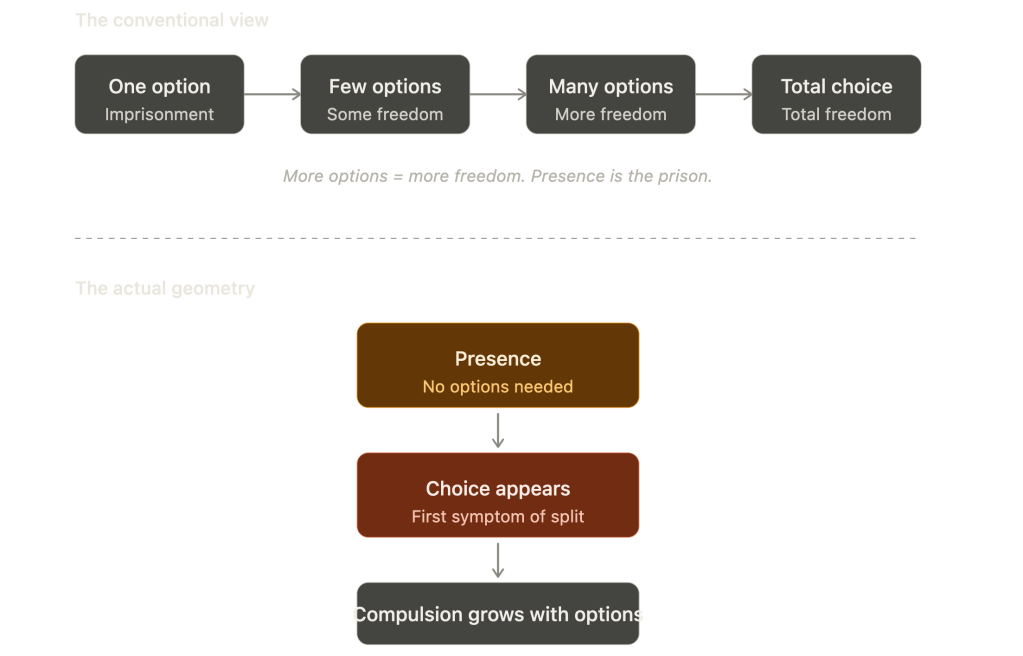
We live in a culture that treats choice as the highest good. More options, more control, more ways to optimize every aspect of life. It is easy, from within that mindset, to read both Eden and Panchavati as stories about oppressive rules and the heroic assertion of autonomy.
But something important is lost when we equate choice with freedom.
Choice is a feature of a mind already split from itself. There is a subject here, objects there, and a restless set of movements — vrittis — juggling preferences, fears, fantasies, and regrets. The more charged the options, the more trapped the chooser feels.
Freedom, in the deep sense, is what exists before that split. It is the state in which you are not compelled by any option at all — not by fear, not by desire, not by imitation, not by resentment. It is not the marketplace of alternatives; it is the absence of inner coercion.
Seen this way, the first act of having a choice — apple or obedience, deer or Rama’s counsel — is already a symptom of lost freedom. A consciousness resting in presence does not experience the prohibition as an insult and the temptation as liberation. It simply does not feel torn. The moment the option becomes a moral drama, we are already some distance down the ladder.
The Oxymoron of Free Will
This is why Swami Vivekananda famously argued that the concept of “free will” is fundamentally an oxymoron. In his Vedantic framework, “will” is inherently bound by the laws of cause and effect; what we experience as an autonomous choice is often just the mind calculating its next move based on the weight of past impressions, conditioning, and desires. To exercise will is to operate entirely within the machinery of causality. True freedom, Vivekananda asserted, does not belong to the mind or its choices—it belongs solely to the Atman, the unconditioned Self. Therefore, to attach “freedom” to the “will” is to try and graft an attribute of the absolute onto an instrument of the relative.
The ultimate exercise of our will is not found in endlessly weighing alternatives, but in the paradox of surrendering the will entirely. When the frantic friction of personal desire drops, we are pulled by the “strange attractor” of the Divine. True freedom is not the power to choose between a thousand glittering deer; it is the absolute, uncoerced state of no longer needing to chase the deer at all.
Nirodhah: The Vehicle Back
Seen through this lens, Patanjali’s terse sentence lands like a quiet thunderclap: Yogah chitta vritti nirodhah — yoga is the cessation of the movements of the mind.
At first blush, nirodhah sounds like the opposite of freedom. A mind without movements? No desires, no internal commentary, no waves? To a modern ear, that sounds like lobotomy, not liberation.
But look again through the lenses of Eden and the Ramayana.
The original sin in both stories is not boredom cured by adventure. It is identification with a specific movement: the vritti that says, I must decide for myself, even against the given wholeness. I will eat. I will have the deer. I will define good and evil on my own terms.
Yoga’s nirodhah does not kill freedom. It suspends precisely those compulsive wave-patterns long enough for presence — the first layer — to become visible again. When the inner commentary quiets, what remains is not numbness but the one condition in which you are not being pushed around by anything.
From the outside, the command in Eden, the Lakshmana Rekha in Panchavati, and Patanjali’s nirodhah all look like limits on freedom. From the inside, they are the scaffolding by which the soul recovers a freedom prior to, and far larger than, the freedom to pick an apple or chase a deer.
The Climb, and the Strange Mercy of Consequence
The good news in all of this is that the ladder is not one-way.
In the Ramayana, the path back is the same sequence in reverse: honor the boundary, and faith becomes possible again; hold faith, and presence returns; return to presence, and the boundary dissolves because it is no longer needed. The saints the tradition remembers — Prahlada in the pillar, Hanuman in his deepest flights, Sita in the fire-ordeal, Mira with the cup of poison — move freely because they have completed, not rejected, the discipline.
Eden, too, has been read mystically as a story whose ending is not exile forever, but a long return. The flaming sword at the garden’s edge is not the tantrum of a rejected deity; it is the symbol of a path that must now be walked with awareness, through history and consequence, back to the tree that was once simply given.
Even causality — the lowest layer, the harshest teacher — turns out to be a form of mercy. Step off a cliff and gravity instructs you. Step outside the line and what waits outside the line will meet you. You will not be abandoned to nothing; you will be held by the way things work until you can no longer pretend that the apple or the deer were neutral toys.
The great irony is this. We fall from presence to causality in the name of freedom. We rise from causality to presence by consenting to what first appears as restraint — a line we choose not to cross, a discipline we choose to keep, a vritti we choose not to feed.
What looked like oppression turns out to be the only vehicle capable of carrying us back to the state where no external control is needed at all.
The Freedom Behind the Apple
Perhaps this is the deepest meaning of original sin: not that a single act long ago doomed everyone, but that there is a recurring movement in human consciousness — a preference for the drama of choice over the quiet of being — and that this movement always feels like liberation from the inside.
The apple is the right to step out. The deer is the right to insist. The serpent’s whisper, the glitter of gold, the mind’s own vrittis: they all speak in the language of freedom.
And yet the stories, read closely, keep pointing elsewhere. They suggest that the truest freedom is not the ability to chase every possibility, but the awakening into a condition where you no longer need to. Presence is not the prison we escape by choosing. It is the home we forgot while we were busy exercising our right to walk out.
Yoga, in this light, is not a denial of freedom but its recovery. Nirodhah is not the end of the story; it is the moment the waves finally rest, and the lake remembers it was sky all along.
This is the third and final essay in The Architecture of Return. The first piece, The Eagerness of Love and the Turning of Desire, reads Hanuman and Sita closely — the small flicker and the larger turning. The second piece, The Four Layers of Refuge, draws out the architecture those readings imply: presence, faith, boundary, causality. This piece widens the lens to find that same architecture in Eden and on Patanjali’s mat — three vocabularies, one architecture.


You must be logged in to post a comment.